


About Intermittent Catheters
Everything you need to know about intermittent catheters.
- Intermittent catheter tip
Intermittent catheters come in two different tip options – straight tip and coude tip. Straight tip is the most common style and has a rounded, straight insertion tip. Coude, which is French for ‘elbow’ or ‘bend’, has a slight bend at the end of the catheter that is inserted. Coude tip is designed to maneuver around obstructions in the urethra like scar tissue or enlarged prostate for those with male anatomy. Please note, you want the curve of a coude tip to face up during insertion to follow the natural anatomy of the urethra during insertion. - Eyelets
Also known as drain holes or catheter eyes, the drainage eyelets of a catheter are found on the insertion tip of a catheter. Catheter eyelets are positioned so that when the catheter enters through the urethra into the bladder, urine drains through those holes. One way manufacturers create a catheter eyelet is by literally punching a hole in the material. This process is known as “cold-punching.” While this will create eyelets that do their intended job, some catheter users find that punched eyelets are rougher. If the edges are not soft, the catheter may create friction or discomfort as it inserts or withdraws. Many catheter products today have polished drainage eyelets, including those by Convatec. Polishing the drain holes makes the edges much smoother, which may feel more comfortable. - Funnel End
The funnel end of your catheter is the end opposite of the insertion tip where your urine comes out. In some catheter brands, the catheter funnel end is shaped more ergonomically for easy gripping, which some people prefer to use as a sort of “no-touch” catheter grip to avoid touching the tube.
Coudé catheters’ funnel ends sometimes feature a helpful raised bump or notch on the funnel to indicate the angle of the curved insertion tip.
Catheter funnel ends can be used as a universal catheter connector to connect the catheter tube to an external receptacle such as a urine drain bag or extension tubing.
Most catheters drainage funnels are color-coded to help identify the French size of their catheter and make sure you’re using the right size for your anatomy every time.
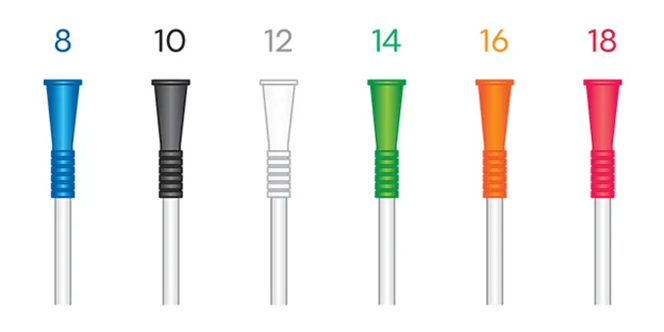
Intermittent catheter sizes include the length and diameter, which is measured in French or Charriere sizes.
French Size: Catheter French sizes generally start very small at 5 or 6 French and progress upward in size, through as large as 24 French.
A universal color-coding system allows you to simply look at the funnel end to make sure you’re using the prescribed French size. With the right French size, urine should flow from your bladder, through the tube, at a steady pace while keeping you comfortable.
- Knowing if your catheter is too small: For catheters that may be too small, you may experience spillage, or urine flowing outside of the tube.
- Knowing if your catheter is too big: For that are too big for your urethra, you may experience discomfort or pain.
If you feel that your catheter is too small or too big, speak with your doctor. You and your healthcare professional can determine together what size and length catheter may best suit your individual needs. Your doctor should take into consideration your preferences as well as your particular anatomy.
Catheter length: Male and female anatomies require different length catheters as the male urethra is longer than the female urethra. However, some women prefer a longer catheter. Your healthcare provider will help you decide the right size and length catheter for you.
- Male length catheters are usually 16 inches (40 cm) in length.
- Female length catheters range from 6-8 inches (15-20 cm) in length.
- Pediatric length catheters typically range from 6-12 inches (15-30 cm) in length.
For children, boys may need to use a pediatric length or longer 12-16 inch (30-40 cm) length catheter to ensure it is long enough to reach the bladder and provide complete emptying. Girls can use either a male or a female short style catheter as the female urethra is much shorter.